Salesforce is a flexible and powerful cloud platform with support for a broad range of business functions including managing products and pricing. In my previous post, Pricing your products with Salesforce Revenue Cloud, I explored the pricing mechanisms available in the latest Revenue Cloud. This article will build on this technical foundation and explore how these mechanisms can support a pricing strategy aimed at optimising the use of pricing as a business tool to gain profit.
As a starting reference point to discussing pricing strategies I recommend the Harvard Business Review article, Managing Price Gaining Profit – 1992, Marn & Rosiello. In this article Marn & Rosiello highlight that the most effective way to maximise profit is to get the price right and demonstrate how this boosts profits faster than increasing volume of sales.
In order to achieve the correct price they describe how price is driven by 3 related areas:
- Industry supply and demand, where factors such as competition and technology reducing costs can have significant effect of industry price levels. Recent AI development is a clear example of how technology can disrupt established practices and reduce costs.
- Product market strategy, which relates to how customers perceive the benefits of products and related services. More benefit means higher prices can be charged and so understanding these important benefit factors is key to maximising what customers are willing to pay.
- Transactions, where the final price is determined through applying discounts, allowances, rebates etc. It is this area where specific customer deal mechanics take shape and this brings us close to the working of Revenue Cloud where quotes are generated and prices managed through a range of price adjusting mechanisms as described in my earlier article.
By looking at price through the above 3 lenses an organisation has an opportunity to achieve the best net price for each order or transaction. In order to explore how Revenue Cloud can support this exercise we can start by establishing some fundamental principals around which a price be established and a pricing strategy can be developed. We can then review how the features of Revenue Cloud as a pricing system can be used to support those fundamental pricing building blocks.
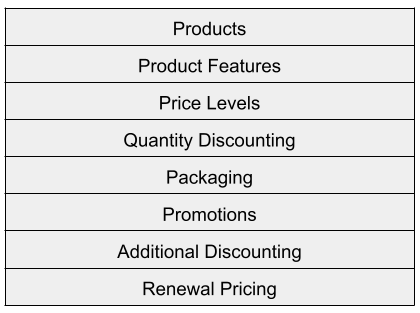
The table below shows a typical initial view on areas and levers to focus on when determining a pricing strategy.
Products & Product Features
How customers perceive the benefits of your products forms the staple core of your pricing strategy. Having the correct products with simple to understand benefit statements is key to reducing sales friction and simplifying the sale process. Products are typically explained using product features and these features are often relied on to explain the value to the customer and sell the products. Having products and features which are packaged together for specific customer requirements makes it simpler for customers to understand the benefits. Developing this theme further a standard pricing tactic is to create Products which segment the market and are positioned in terms of the levels:
- Entry
- Standard
- Premium
A portion of your customers may want to start simple and choose an entry product with potential for then migrating to other features later as their understanding of your product develops and the value of other features becomes clearer. Alternately, some of your customers may want to start with a premium product which is feature rich and covers all of the scenarios without having to return to the buying process.
Having the correct products positioned accordingly in line with above is a well recognised pricing tactic. It also starts us thinking about product simplification and basic product bundling. To allow customers to make simple decisions based on benefits where we do not want to present too many product options with potential for confusion. So by creating our customer facing products using some broad definitions which allow us to segment the target market and simplify the benefit messages makes sense.
Salesforce Revenue Cloud defines our products using the Product object and associated records. These contain product definitions and are referenced directly in our sale quote as line items within the quote. Product records which are presented through the sale quote are our sales products – they are what the customer sees as part of the sales process. It may well be that these products need to be processed and delivered in conjunction with other products in order to provide a customer solution. Revenue Cloud allows us to do this by associating technical products with commercial products and using decomposition rules to arrive at the full list of products for ultimate delivery to the customer.
Within Revenue Cloud we can also associate products with attributes. These attributes are characteristics of a product which can typically be configured as part of the sales process based on customer requirements. So we could have a single product record which is then subsequently configured by selection of the Entry, Standard or Premium attribute values for example. Common examples of attributes are physical features associated with a product such as screen size, colour, processor speed etc.
Selection of the required attribute values takes place within a configuration process following product selection when building a sales quote in Revenue Cloud and sets up our product definitions for subsequent pricing as described in the sections below.
Having the correct product definitions with appropriate use of techniques such as attributes forms the fundamentals for effective price management and optimisations for profit. Product definition should therefore be given significant thought and analysis as part of implementing Revenue Cloud.
Price Levels
Having established our Products and Features required for the sales process we now need to establish a price level which forms the starting price point when presenting our products to the customer. Understanding our customers and markets well allow us to use price levels as a lever to maximising revenue and profitability. So for example some customers will pay more for certain products because of the value of the product to that customer. We may want to offer certain customers a discounted price point to enable traction in a specific customer segment ie a discount for not for profit is common. So by analysing our customers and markets in terms of the value our products deliver and the strategic opportunities presented we can segment our customers with appropriate pricing.
Revenue Cloud supports price segmentation through Price Books. Each Price Book will contain a price book entry for each product referenced within the Price Book. Using the price book entry we establish a list price for the product.
Revenue Cloud additionally supports different pricing models within products eg one time charge, monthly price, annual, and each of these price models has a distinct price book entry within the price book.
Price Books therefore allows us to segment our price levels and Revenue Cloud will ask us to select a specific price book for each customer sales quote. The selection of the Price Book can be automated through a custom flow and this can allow us to choose a specific Price Book and associated price levels based on specific data points referenced in the sales quote such as customer location or industry segment.
Configuration of a product through selection of the attribute values as described above can also have an impact on price. As per our earlier example of Entry, Standard or Premium we want our product price to adjust accordingly and this is managed in Revenue Cloud using Attribute Based Price Adjustments. These adjustments can represent specific amount adjustments from the price book entry list price, or a percentage adjustment applied to the list price, or an override price replacing the list price.
Through this combination of price book selection and attribute configuration Revenue Cloud can quickly establish the correct price level for your products within a sales quote and ensure you have an accurate starting point for your sales process.
Quantity Discounting
Quantity Discounting, or the more you buy the lower the price, is a mechanism to encourage higher volumes of sales hence increasing the revenue associated with a sale while decreasing the unit profit margin for products where price is discounted. Revenue Cloud provides a straightforward mechanism to support quantity discounting on a product by product basis. Price adjustment tiers can be setup based on lower and upper bound quantity values. From these tiers prices can be adjusted in terms of specific amount discount, percentage discount, or an override price.
The discount can be separately applied on a volume tier by tier basis [slab pricing], or can be applied across the entire range of the chosen quantity [range pricing].
Discounting price based on accumulated volume of separate products sold is a similar price tactic encouraging cross selling of products with overall totals leading to price discounts. Revenue Cloud will support this through a small amount of custom configuration using its Aggregate Price element which can group product lines and sum totals which can be used to drive discounts through the Formula Based pricing element where a calculation such as a discount can be applied to arrive at an updated net price.
Packaging
Packaging of products, or as it is often termed, bundling, is a method to present appropriate or required products which are sold together. Based on the customer, and the product value propositions, a bundle of products can be a simple mechanism to present products to the customer for consideration eg. customers in your segment typically buy these products. As a bundle starting point this may have no immediate impact on product pricing. Customers can choose from the bundle which products they require.
Alternately, the use of product bundles can bring into play price adjusting levers which add extra flexibility in establishing a price across a collection of associated products. Techniques here include:
- Pricing the top level bundle product to include the price of the bundle components.
- Bundle based price adjustments where the bundle components are priced separately but discounted by being part of the bundle.
Use of product bundles can therefore be very effective at both steering the sales process to promote the correct products for the customer, and for pricing incentives based on bundle selection
Revenue Cloud supports these packaging techniques by providing for product bundle definitions using Child Component relationships between products and Bundle Based Price Adjustments supporting the models described above. .
Promotions
One-off, time based promotions are often used to drive sales activities and promote products. Typically seasonal type offers or customer segment specific events are used to generate sales activities.
Revenue Cloud provides for these time based specific promotions using a Price Adjustment Matrix. This consists of a custom price table which can present time bound pricing for specific products with options for price discounts based on specific discount values or percentage discounts or override price capabilities. Additional custom logic can also be incorporated into the Price Adjustment Matrix providing for flexible discounting rules utilising data points across the customer and product data records.
Additional Discounting
Additional price discounting is typically negotiated at point of sales in the form of special or quote by quote discounts agreed with the customer as part of the sales process. These manual discounts are the time served way of providing special discounts to serve the needs of the buyer or the seller.
Revenue Cloud provides for this discount capability through its Manual Discount pricing element providing for a specific discount value or a percentage based discount value to be applied on a quote line basis.
A Discount Distribution pricing element can also be used to spread a quote level discount across the individual products while also respecting specific product floor prices as part of the discount calculations.
An important consideration with manual additional discounts is governance and control of the discount being offered. This is referenced in Marn & Rosiello mentioned above as the first action to take in reviewing your pricing strategy – bring over discounted accounts back in line, and set clear decision rules eg. cap exception discounts at 5%.
Revenue Cloud Advanced Approvals provides for the design and build of Approval workflows with rules, steps and stages to control discount approval submissions using approval organisation hierarchies with action outputs based on acceptance or rejection of requested discounts.
Renewal Pricing
With products or services which are sold as term based products ie subscriptions, the subscription renewal provides a convenient point in time as well as an additional pricing lever to maximise revenue and profit.
Renewal pricing can however be a double edge sword in terms of customer relationship. For example recent legislation in the UK has forced insurance policy renewal price increases to match prices being offered to new customers – avoiding the situation where existing customers were subsidising new customers. A situation which would also no doubt encourage customer churn to avoid renewal hikes in price.
Using Revenue Cloud a subscription product is managed through the customer lifecycle as an Asset entity. This entity can track the price book entry which was used to provide the initial list price as well as the eventual agreed sales price. On subscription renewal a renewal price can be established based on either of these two data points. With the additional option through simple customisation to adjust the price eg. increment based on a retail price index figure which is common practice.
Plus all of the above described pricing elements are available for the renewal pricing quote providing an organisation flexibility in maintaining customers and maximising revenue through subscription renewals.
Summary
In this article we have taken a look at some of the main areas and pricing levers used to build a pricing strategy and how Salesforce Revenue cloud as a pricing system can support an organisations pricing strategy.
Using the basic architectural components of Products, Attributes, Price Books, Price Book Entries, and a variety of customisable pricing elements we have touched on how Revenue Cloud can support an organisations product and product feature definitions, price levels, quantity discounting, product packaging and bundling, promotions, renewal pricing and discounting governance.